|
|
Rose Bowl Parade Pro-Union Song!
Jan 16, 2012 (11:21:44)
Union Maid’s Rose Bowl Appearance
Just about the last thing TV viewers of the Rose Bowl Parade expected was a hearty marching band rendition of the classic Woody Guthrie song Union Maid (Oh you can’t scare me, I’m sticking to the union… etc.). But that’s exactly what they got courtesy of the Pulaski, WI High School Marching Band. Check out these great kids, especially about 1:15 minutes into their gig. Take that, Gov. Walker! Click here to watch the video.
|
|
|
|
2011 Special Legislative Session Plea
Dec 11, 2011 (07:58:10)
From W.S.C.F.F. President Fox
Another Special Session in 2011 - We will need your help!
In 1866, a judge in New York heard the case of an attorney who was accused of negligence for not reading the most current state statutes before advising a widow on the settlement of her husband’s estate. The judge, in his ruling, stated what is only too true today in Washington State: “No man’s life, liberty, or property is safe while the legislature is in session.”
Now why bring up this old quote? Because the state has a $2 billion dollar deficit and no source of revenue is sacred. The LEOFF Plan 2 retirement fund has become the ever-present cookie jar for House Ways and Means Chair, Ross Hunter. He proposes to reduce the funding to our plan despite reports and recommendations that clearly indicate that his proposal is inconsistent with the LEOFF Plan 2 Board’s risk management goals. The latest scheme would reduce the State’s contribution by $18 million and reduce overall funding to the plan by $90 million over the next 18 months. It is short-sighted and jeopardizes the long-term funding of our pension plan. We are essentially being forced to lower our contributions today, knowing we will have to make up for this forced reduction in future years … at a time when we are still realizing losses from the Great Recession! It is financially irresponsible to “kick the can down the road”, notwithstanding that this proposal will challenge the statutory authority of the LEOFF Board.
Leaders from each local need to inform their members to sign up for the Legislative email update and go to www.wscff.org to stay informed and to be able to reply to our call for action. If you need more information, go to www.leoff.wa.gov, the website of your LEOFF Plan 2 Retirement Board. Begin a conversation at the firehouse, during your lunches or your breaks. This is the future of your pension – be informed, be ready to take action and respond when needed!
|
|
|
|
|
|
|
|
Larry Steagall. First Place (Again)
Oct 12, 2011 (22:56:00)
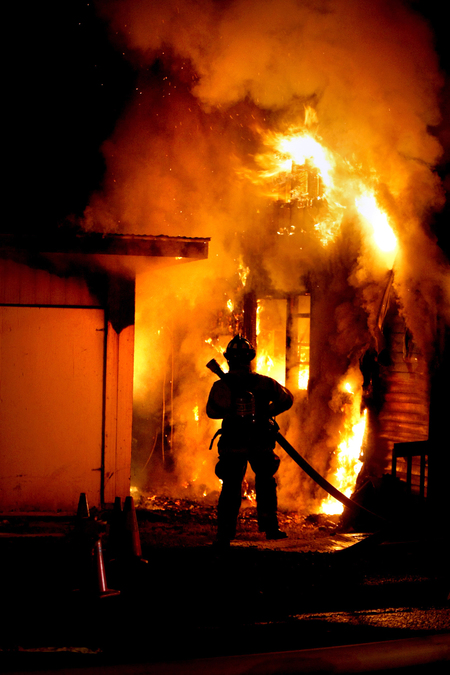
FIRST PLACE (2011 I.A.F.F. Media Awards): “Two Bremerton-Area Houses Destroyed by Fires” Kitsap Sun
Photo by: Larry Steagall
Submitted by: Bremerton, WA Local 437

|
|
|
|
Little Love For Labor
Sep 13, 2011 (12:25:52)
I didn’t learn much about the labor movement in high school. At best, it was taught like suffrage—a long-ago response to long-ago problems. At worst, it was taught like prohibition—curious, misguided, and painfully anachronistic. Most of the time, my history classes didn’t discuss the labor movement at all.
Turns out I wasn’t the only one.
Last week the Albert Shanker Institute, a think tank endowed by the American Federation of Teachers, released a report, American Labor in US History Textbooks, documenting the movement’s compressed portrayal in our major textbooks. It offers a stark assessment: “If, while driving to school, students happen to see the bumper sticker: ‘Unions: the Folks Who Brought You the Weekend,’ that may be more exposure to American labor’s historic role as a force for social progress than they will ever get in the classroom.”
Three historians wrote the report after reviewing the main high school history textbooks of the four chains that together dominate the industry (if you’re an American high school student, chances are your textbook is one of them). They found that the textbooks portray strikes as violent, disruptive, and socially negative, while downplaying employers’ role in instigating violently repressing job actions. Social and economic reforms like the New Deal are credited to visionary politicians and the critical pressure from labor protests is studiously minimized. Social movements for civil rights and women’s equality are divorced from labor concerns or participation. With the exceptions of the United Farm Workers organizing and air traffic controllers getting fired, unions virtually disappear from the textbooks after 1960—as does workplace injustice.
The textbook The Americans tells students that President Truman “refused to let strikes cripple the nation,” and says that “Labor unions benefited” from the National Industrial Recovery Act, without mentioning their role in securing the historic legislation. United States History writes that the legacy of the Haymarket incident (the inspiration for May Day) was that, “Employers became even more suspicious of union activities, associating them with violence.” American Anthem mentions “images of workers being beaten or killed” as the kind of “negative publicity” General Motors had to avoid when its workers went on strike.
Taken together, such portrayals make it easy to come away with the sense that unions were an understandable response to sweatshop conditions in the past, but have been rendered unnecessary, and even counterproductive, given contemporary legal regulations and a more enlightened business class. Not coincidentally, that’s the impression you’d get from a lot of our newspapers, politicians, and TV shows too. Meanwhile, Walgreens fires an 18-year worker for grabbing a bag of chips to ward off a diabetic attack.
As the report's authors note, there are moral and strategic failures as well as successes in the history of the American labor movement, and students should be taught both the proud and the shameful. High schools that treat union members like free masons are doing students a disservice. They obscure important stories and ideas, while reinforcing familiar bad ones: that injustices that are bad enough will eventually get fixed without need for organizing; that what happens at work stays at work; that change comes from the top; that we should measure how democratic our economy is by how many products are available to buy.
The least we owe our students is to try to tell them the truth.
|
|